Species
Included & Habitats |
|
ORDER - ISOPODA |
|
Taxonomy
& Pest Status |
| |
|
|
| |
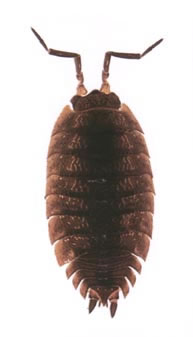
Over 30 species of
woodlice are common in Britain, hence we will deal with them in
general terms as most are similar morphologically and
behaviourally.
The majority of these species are
outdoor organisms, some of which are of horticultural significance
when they attack plants.
Some woodlice enter dwellings in
the cooler autumn and winter months when they may be seen as
pests. |
|
| |
|
|
|
|
|
|
| |
|
|
| |
Class: |
Crustacea |
|
| |
Order: |
Isopoda |
|
| |
Family: |
Various |
|
| |
Crustacea
is a large order, most members of which are aquatic.
The woodlice are possibly the best
known land living creatures of this class.
Woodlice are generally harmless
casual invaders of homes.
|
|
| |
|
| |
|
|
|
| |
|
| |
|
| |
|
| |
|
| |
|
| |
|
| |
|
| |
|
| |
|
| |
|
Biology |
|
Woodlice |
|
Control |
| |
|
|
| |
Unlike insects,
crustaceans do not have internal channels for moving gas vital to
respirations, and use surface area and external gills for the
purpose of gas exchange. They are particularly sensitive to water
loss and are usually found in damp surroundings. |
|
| |
|
|
|
|
|
|
| |
|
|
| |
As woodlice are
essentially harmless organisms which do not breed indoors, and
tend only to venture inside dwellings for shelter, simple cleaning
and proofing of entry points should suffice.
Refuse and harbourage areas
adjacent to the perimeter of buildings should be minimized.
If necessary, a residual barrier treatment should prevent access. |
|
| |
|
|
|
| |
|
| |
|
| |
|
| |
|
| |
|
| |
|
| |
|
| |
|
| |
|
| |
|
| |
|
|
|
|
|
|
|


