Habitat |
|
Widespread throughout Europe, hide beetles all require a diet which is high in protein. Occurring naturally in birds nests, this group of insects is well adapted to infesting intensive poultry units, and is one of the main pests of such areas.
|
Biology |
|
Adult females lay between 200 to 800 eggs which hatch within around 1 week. After a number of moults, larvae leave the food source in search of a suitable site for pupation. Such sites include wooden panels and structural timber which the larvae may burrow into. Total life cycle may be completed in 8 - 12 weeks.
|
|
|
Dermestes lardarius
Insecta Coleoptera Dermestidae
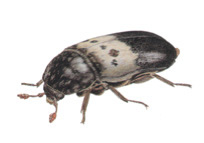
Image Copyright - Aventis Environmental Science 1964. Reproduced with kind permission of Aventis Environmental Science.
Send this page to a friend
|
|
Pest Status |
|
A serious pest of kitchens, poultry houses and occasionally, piggeries.
Feeding on and breeding in proximity to food scraps, the presence of hide beetles may indicate poor hygiene.
|
Control |
|
Removal of sources of food, and the use of sealed containers for storage is recommended.
Where applicable, residual insecticides may offer control, and should be targeted to cracks and crevices.
In animal rearing situations, a "Band" of residual insecticide applied to walls and pillars may be effective in targeting migrating insects.
|
|