Habitat |
|
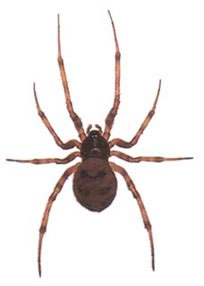
Distributed to the point of ubiquity. Spiders can be found in almost any environment on earth. Some estimates state that as many as 2 million spiders may be found per acre of rough grassland. In the urban environment, most spiders are to be found in dark secluded harbourage, although this is often near to an area where they may acquire prey items, sometimes by the use of their characteristic webs.
|
Biology |
|
All spiders follow incomplete metamorphosis life cycles. Young spiders are like miniature adults in appearance, growing through several moults to adulthood and sexual maturity. All spiders secrete silk although only some produce webs. Silk is often indicative of the presence of this group. Spiders are generally clean and fastidious, exhibiting frequent grooming behaviour.
|
|
|
Pest Status |
|
Although the vast majority of spiders are without a doubt beneficial insects due to their habits of preying upon other insects including real and genuine pests, public opinion does not favour this group of invertebrates. Many people are phobic to a greater or lesser extent and so spiders are often treated when not strictly necessary. Some species of spider however are dangerous, such as the Black widow, Funnel Web and Brown Recluse. These pests should be treated with extreme caution.
|
Control |
|
Unless the species of spider is a poisonous species, control is rarely necessary. If the offending spider is to be removed, a cup and sheet of card often suffice to capture and release the spider. Vacuum cleaners are also useful in removing webbing.
|
|