Habitat |
|
Frequently found in poultry houses, and easily identified by their erratic flight pattern. Large numbers may be seen flying around indoor light fittings. F. canicularis is more cold tolerant than M. domestica, overwintering typically in the pupal form, although adults may remain active year round in temperate conditions.
|
Biology |
|
Females commence egg laying at around 10 days after emergence. Larvae will hatch from eggs within 24 - 48 hours. Minimum larval development period is 8 days, during which time, it will pass through 3 larval instars. Pupation occurs in darker, drier areas, and typically lasts 10 days. Generally, the full cycle may be completed in 3 weeks, although this is directly linked to conditions.
|
|
|
Fannia Canicularis
Insecta Diptera Muscidae
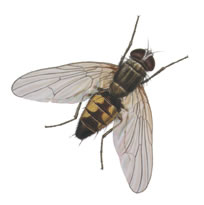
Image Copyright - Aventis Environmental Science 1964. Reproduced with kind permission of Aventis Environmental Science.
Send this page to a friend
|
|
Pest Status |
|
Significant as vectors of disease, houseflies transmit intestinal worms, dysentery, gastro-enteritis, typhoid, cholera and tuberculosis. As they will feed indiscriminately on faecal matter and human food, their status as a vector is well noted. Flies liquefy food by regurgitating digestive juices, stomach contents and enzymes onto food before ingestion.
|
Control |
|
Flies are a highly significant public health pest. Hygiene management is critical to the control programme, with harbourage and breeding site minimisation. Refuse and manure should be removed as frequently as possible. Where possible, sealed refuse containers should be used. Insecticidal measures will often be necessary.
|
|