Habitat |
|
Being sub-tropical in origin this pest is indigenous to Europe. Often found in and around foodstuffs, and occasionally in grain. May also be seen wandering on walls and windows as well as on carpets. Birds nests, animal remains and dead insects are focal points for populations which thrive on the source of protein.
|
Biology |
|
Mating occurs immediately subsequent to emergence. Females produce between 20 and 100 cream coloured eggs which are approximately 0.5mm in length, with spines at one end. Hatch will occur within 2 - 4 weeks, whereupon the characteristic "wooly bears" move through a number of instars before reaching adulthood. Pupation lasts 10 - 30 days. Adults are capable of flight.
|
|
|
Anthrenus Sp
Insecta Coleoptera Dermestidae
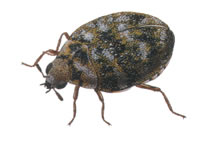
Image Copyright - Aventis Environmental Science 1964. Reproduced with kind permission of Aventis Environmental Science.
Send this page to a friend
|
|
Pest Status |
|
Larval forms cause significant damage to keratin containing products such as wool, fur, leather, silk and dried animal remains. Although no webbing is created by this pest, its activities are indicated by the presence of clean, irregular holes in textiles in the vicinity. Quantities of larval skins or exuvia will also indicate presence of this pest.
|
Control |
|
Wide areas may be infested, which means that it is important to trace the source of infestation. Infested nests and animal remains should be removed. Surveillance and regular cleaning should be maintained, and where necessary, appropriate residual insecticide treatments should be considered.
|
|